
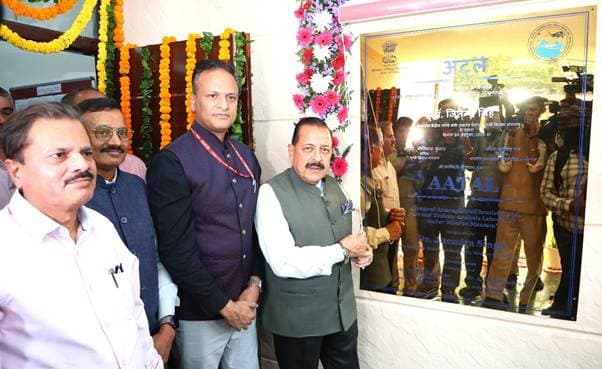
New Delhi: Union Minister Jitendra Singh inaugurated a new air pollution analysis laboratory in Delhi on 24 October, 2026, giving scientists a facility to identify the sources and chemical composition of pollutants affecting Delhi-NCR.
The Integrated Atmospheric Chemistry and Aerosol Toxicity Analysis Laboratory (AATAL) has been established under Mission Mausam. It combines atmospheric monitoring, chemical testing, and pollution-source analysis to provide information beyond the Air Quality Index (AQI).
The inauguration took place at the India Institute of Tropical Meteorology’s (IITM) Delhi Branch in the presence of Earth Sciences Secretary T. Srinivasa Kumar, IITM Director A. Suryachandra Rao and India Meteorological Department Director General Mrutyunjay Mohapatra.
Live Data to Pinpoint Pollution Sources
AATAL will examine pollution from vehicles, industries, crop-residue and biomass burning, construction dust and sources outside Delhi-NCR. Its instruments can analyse PM2.5, atmospheric gases, metals and other components that influence air quality and may pose health risks.
During the launch, Singh referred to a live display that showed transport contributing around 25% of Delhi’s pollution, with the overall reading at approximately 180. He said identifying the contribution of individual sources would give authorities a clearer basis for deciding where action was needed.
“Earlier, the discussion would largely revolve around whether the pollution level was 100 or 200,” Singh said, explaining that the new facility would help establish what the pollution contains and where it comes from.
AIRWISE Provides Forecasts at 400-Metre Resolution
AATAL is integrated with IITM’s AIRWISE, the Air Quality Warning and Integrated Decision Support System for Emissions. The platform combines monitoring data, forecasts and source-apportionment information.
According to the project team, AIRWISE provides forecasts for the next 72 hours at a spatial resolution of 400 metres. This allows pollution levels and likely sources to be examined across individual pockets of Delhi rather than treating the city as one uniform area.
Singh said the combined system would provide real-time information and advance forecasts to help authorities prepare for changing conditions.
CAQM to Use Data for Targeted Action
Dr. Sachin Ghude, Project Director of MAQWS, said the facility would provide the Commission for Air Quality Management (CAQM) and other agencies with detailed evidence on the sources driving pollution.
The data could help officials prioritise sectors and locations for intervention and assess the impact of measures already taken. It may also inform preventive action and responses under the Graded Response Action Plan (GRAP).
Ghude said the high-resolution forecasting system could eventually be extended to other cities.
Analysis to Cover Potential Health Risks
Beyond measuring pollutant concentrations, AATAL will examine their chemical makeup, including metallic and potentially toxic elements. This distinction matters because pollutants with similar concentrations may have different health implications.
Singh called for closer coordination between scientific institutions, environmental authorities, health agencies and disaster-management bodies. He said pollution could not be tackled effectively if government departments worked in isolation.
The facility brings scientific measurement and forecasting into the same framework, with the aim of giving pollution-control agencies more specific evidence for decisions across Delhi-NCR.