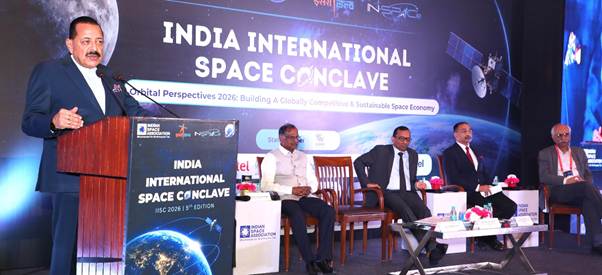
New Delhi: India's space economy, currently valued at nearly USD 9 billion, is projected to grow to USD 40–45 billion in less than a decade, driven largely by private-sector participation and policy reforms, Union Minister Dr Jitendra Singh said on 24 November.
Addressing the fifth India International Space Conclave 2026 in New Delhi, the Minister said India's space ecosystem had expanded from a handful of startups to nearly 400–500 companies in just a few years. He attributed this growth to reforms introduced under Prime Minister Narendra Modi, which opened the sector to private enterprises.
The two-day conclave, organised by the Indian Space Association (ISpA) on 23–24 November, was held under the theme Shaping the Future of Space through Innovation, Governance, Human Potential and Global Collaborations. The event also witnessed the launch of the report Space Economy 2036: The India Blueprint.
Space Sector Reforms Expand Private Participation
Dr Singh said the establishment of NewSpace India Limited (NSIL), followed by the creation of IN-SPACe and the opening of the sector to private participation, had transformed India's space industry.
He cited the progress of startups such as Skyroot and Agnikul, which are developing launch vehicles, rocket engines and advanced propulsion systems. He also highlighted the growth of private capabilities in earth observation and satellite imaging.
Referring to Skyroot's maiden launch vehicle flight on 18 July 2026, its multi-mission launch agreement and unicorn status, the Minister described these developments as important milestones in India's emerging private space industry.
Space Technology Expanding Across Economic Sectors
The Minister said the contribution of space technology should not be measured only through rocket launches, satellite manufacturing and commercial revenues. Its wider economic value also comes from savings, improved efficiency and better outcomes across sectors.
Citing the PM Gati Shakti National Master Plan, he said space-based applications support infrastructure planning, project monitoring, cost reduction and the prevention of wastage and leakages.
He added that space technology had applications across ministries and sectors, including construction, communications, education, healthcare, railways and defence.
During an interactive session, Dr Singh said the perceived lack of demand for space services was partly due to limited awareness of their practical applications. He called for greater inter-ministerial coordination to expand the use of space-based solutions in public services and infrastructure.
Indigenous Capabilities and Global Cooperation
Responding to a question on strategic sovereignty and international cooperation, the Minister said the two were not contradictory. He emphasised the need to strengthen indigenous sources, technologies and projects while remaining open to mutually beneficial international partnerships.
He also highlighted India's progress under the National Quantum Mission, launched in 2023 with an eight-year mandate. According to him, India had achieved 1,000 kilometres in secure quantum communication within three years, against an original target of 2,000 kilometres over eight years.
Dr Singh said space, quantum technologies, semiconductors and nuclear science were interconnected areas with opportunities for technological advancement and commercial growth.
Minister Calls for Greater Private Investment and Research Funding
The Minister urged domestic companies to increase investments in the space sector and encouraged industry leaders to facilitate greater overseas investment into India's space ecosystem.
He referred to initiatives such as the Anusandhan National Research Foundation and the Research, Development and Innovation (RDI) Fund as mechanisms to strengthen research and encourage private-sector participation.
He also called on industry leaders to direct greater Corporate Social Responsibility (CSR) funding towards research and scientific development. Stressing the importance of scientific philanthropy, he said CSR support should benefit the wider community rather than remain limited to machinery and infrastructure.
Suggestions raised during the conclave included an international space innovation alliance, a global accelerator programme for startups and international grand challenges to encourage innovation. The Minister said India should adopt global strategies and benchmarks while exploring opportunities for wider international cooperation.
Industry Participation and Future Growth
The conclave was attended by ISRO Chairman and Department of Space Secretary Dr V. Narayanan, IN-SPACe Chairman Dr Pawan Kumar Goenka, Indian Space Association Director General Lt Gen Anil Kumar Bhatt (Retd), Arun T. Ramchandani and other representatives from the space and technology sectors.
Dr Singh also welcomed suggestions on expanding the space ecosystem to more states and increasing opportunities for students and young innovators.
He said policy reforms, indigenous technological capabilities and private-sector entrepreneurship were creating the foundation for India's emergence as a globally competitive space economy.