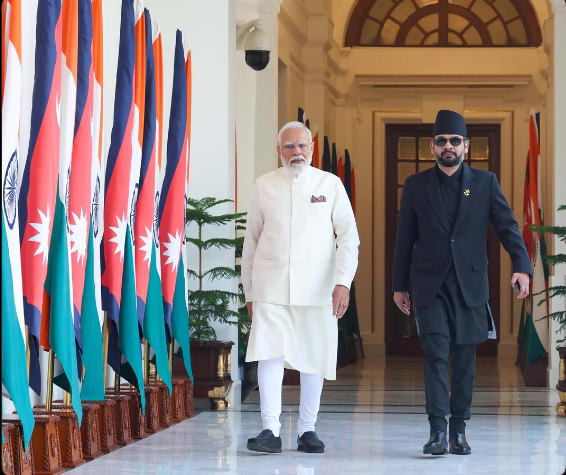
New Delhi: Prime Minister Narendra Modi held bilateral talks with Nepal Prime Minister Balendra Shah at Hyderabad House in New Delhi on Monday, 23 November 2026, during the latter's first bilateral visit abroad since assuming office in March.
The discussions focused on strengthening India-Nepal ties, with particular emphasis on hydropower cooperation, railway connectivity, trade, investment and reconstruction assistance following the devastating glacial floods that hit Nepal in August 2026.
Shah arrived in New Delhi on 22 November for a two-day state visit at Modi's invitation. He received a ceremonial welcome and Guard of Honour at Rashtrapati Bhavan, with Modi present.
The two leaders were also scheduled to virtually flag off the Saryu-Kamala Express, a weekly passenger train connecting Ayodhya Cantonment in Uttar Pradesh with Janakpur Dham in Nepal.
Energy and hydropower cooperation
Energy cooperation featured prominently in the discussions, with both countries looking to expand cross-border electricity trade.
Under the existing long-term power trade agreement, India plans to import up to 10,000 MW of electricity from Nepal over the next 10 years. Current annual imports stand at around 1,200 MW.
During the 2025-26 financial year, Nepal earned approximately NPR 1,800 crore in net revenue from electricity exports to India.
Indian companies are also involved in major hydropower projects in Nepal, including the 900 MW Arun-3 project.
India discusses $2 billion assistance package for Nepal
India and Nepal are discussing a development assistance package of up to $2 billion, a significant portion of which could support reconstruction following the August 2026 glacial floods.
The floods damaged homes, infrastructure and hydropower facilities, particularly in the Bhotekoshi-Rasuwa corridor.
The proposed assistance could combine grants and concessional loans to support projects in infrastructure, education, healthcare and hydropower.
Railway and cross-border connectivity projects
Connectivity was another key area of discussion, with both sides reviewing ongoing and proposed infrastructure initiatives.
The proposed Raxaul-Kathmandu railway project, integrated check posts and improved air connectivity were among the issues on the agenda.
The discussions also covered progress at integrated check posts, including those at Bhairahawa and Banbasa, as well as new air routes that could improve access to Nepal's international airports at Pokhara and Bhairahawa through Indian airspace.
The Saryu-Kamala Express is another significant initiative aimed at strengthening passenger connectivity between the two countries.
MoUs and investment initiatives on the agenda
India and Nepal are expected to exchange memorandums of understanding covering several areas, including:
Education and healthcare
Agriculture and sports
Disaster management
Human resource development
Several completed connectivity and energy projects are also likely to be inaugurated virtually, while foundation stones for new initiatives may be laid.
A broader joint vision document, referred to in some reports as 'Samriddha Nepal, Samunnat Bharat' (Prosperous Nepal, Developed India), is also under discussion.
A Nepal-India Business Forum forms part of the programme, with the aim of attracting greater Indian investment into Nepal.
Nepal's 34-member delegation includes Finance Minister Swarnim Wagle, Foreign Minister Shishir Khanal and Chief Adviser Kumar Byanjankar.
Significance of the Modi-Balendra Shah meeting
India remains Nepal's largest trading partner and a major source of foreign investment, while also serving as its principal transit route for trade.
The visit comes as both countries seek to strengthen economic, energy and people-to-people ties while addressing practical challenges involving disaster reconstruction and cross-border movement.
Shah, 36, is also scheduled to call on President Droupadi Murmu during his visit. The two prime ministers are expected to jointly address the media following their discussions.
The outcomes of the visit, particularly on electricity trade, railway connectivity and reconstruction assistance, are expected to shape the next phase of India-Nepal economic cooperation.