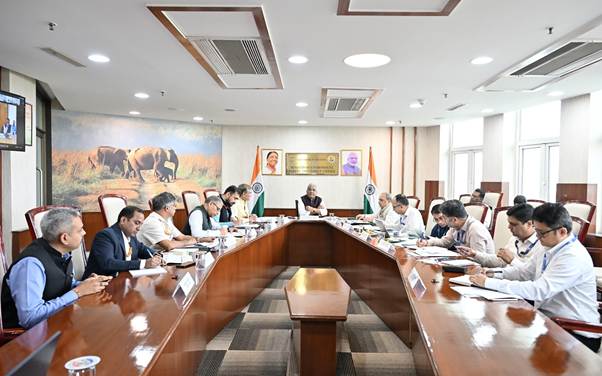
New Delhi: Union Environment, Forest and Climate Change Minister Bhupender Yadav has directed Delhi, Haryana, Uttar Pradesh and Rajasthan to intensify measures to control air pollution across the National Capital Region (NCR), stressing the need for coordinated and time-bound action as winter pollution levels rise.
The directions were issued during a review meeting assessing the implementation of air pollution control plans across the four regions. Yadav said more than 30 review meetings had been held with NCR state governments and municipal bodies over the past year to strengthen preparedness and monitor implementation.
Environment Ministers Manjinder Singh Sirsa (Delhi), Rao Narbir Singh (Haryana) and Arun Kumar Saxena (Uttar Pradesh) attended virtually. Senior officials from the Ministry of Environment, Forest and Climate Change (MoEFCC), the Central Pollution Control Board (CPCB) and the Commission for Air Quality Management (CAQM) also participated.
CAQM Member Secretary Tarun Pithode presented the progress made by NCR states, while CAQM Chairperson Rajesh Verma reviewed the implementation of state action plans and pending measures.
Accountability and Enforcement at the Centre of Review
Yadav asked agencies to move beyond planning and ensure strict enforcement on the ground. He emphasised that pollution control measures must be implemented consistently across state boundaries, with real-time monitoring through Integrated Command and Control Centres (ICCCs) and accountability fixed for field-level officers.
States were directed to nominate Secretary-level officials to oversee pollution control in 15 cities: seven in Haryana, four in Uttar Pradesh and four in Rajasthan. These officials will conduct field visits and submit weekly progress reports to CAQM.
The Minister also asked CAQM to issue notices to officers who fail to deliver on assigned responsibilities.
On vehicle pollution, Yadav directed states to install Automatic Number Plate Recognition (ANPR) cameras. He warned that if the systems are not installed by 30 November 2026, CAQM would initiate criminal prosecution against officials responsible in the Transport Departments.
The CPCB was directed to immediately seal 191 identified polluting industries that had not placed orders for installing Air Pollution Control Devices (APCDs), despite repeated instructions.
Regular reviews of state-level hotspot action plans will be conducted by senior officials from MoEFCC, the Ministry of Housing and Urban Affairs, CPCB and CAQM. The Union Minister and state ministers will also undertake field inspections.
Strict Implementation of GRAP and Winter Action Plans
The Minister called for strict enforcement of the Graded Response Action Plan (GRAP) and asked NCR states to adopt Delhi's hotspot-focused winter action plan. The measures cover traffic management, work-from-home arrangements, construction restrictions and prevention of open burning.
Under a CAQM order dated 30 October 2026, dust-generating construction and demolition activities have been restricted across NCR from 5 to 20 November 2026.
Road Dust and Traffic Congestion
Reviewing road dust control, Yadav noted that only 3,221 km of roads had been redeveloped against a target of 5,480 km.
Road-owning agencies were asked to prioritise pothole repairs, damaged footpaths, central verges and end-to-end paving in line with CAQM guidelines. The Minister also called for AI-based video surveys to monitor road conditions.
Mechanical road sweeping machines must be fully utilised and operated in double shifts, supported by digital tracking and AI-based monitoring through ICCCs. States were also asked to intensify deep-cleaning drives and remove accumulated silt, construction waste and municipal garbage.
For traffic decongestion, agencies were directed to take immediate action at 233 identified congestion points across NCR and conduct fresh assessments to identify additional problem areas.
The Municipal Corporation of Delhi (MCD) has been asked to complete the installation of Multi-Lane Free Flow systems at 154 entry points along Delhi's borders by 31 December 2026.
Measures to Curb Vehicular and Industrial Emissions
Yadav called for faster implementation of the PARIVARTAN Scheme to replace pre-BS-VI trucks and buses with BS-VI, CNG and electric vehicles by 2028.
Uttar Pradesh, Rajasthan and Haryana were asked to accelerate beneficiary registration by organising state-level PARIVARTAN Melas. States were also directed to expedite ANPR-based monitoring at fuel stations, integrated with VAHAN and Pollution Under Control Certificate (PUCC) databases, to identify and restrict the use of old and polluting vehicles.
On industrial emissions, the Minister noted that 2,298 of the 2,345 targeted industries, or 98%, had been connected to Online Continuous Emission Monitoring Systems (OCEMS). The remaining 47 units had been closed or sealed.
He called for strict enforcement of the particulate matter emission limit of 50 mg/Nm³. Industries failing to meet the prescribed standards could face closure, electricity disconnection or sealing.
Under the CPCB's winter enforcement Standard Operating Procedure, effective from 1 October 2026 to 28 February 2027, OCEMS-based alerts and monitoring cells have been operationalised across NCR.
State Pollution Control Boards were also asked to help micro, small and medium enterprises access financial assistance under the Swachh Pawan Neel Gagan, Swasth NCR (SPNG-NCR) Scheme for installing APCDs.
Waste Management and Prevention of Open Burning
The Minister asked states to address a gap of 6,747 tonnes per day in municipal solid waste processing capacity and strengthen action against open dumping and burning.
He called for faster remediation of legacy waste at the Okhla, Ghazipur, Bhalswa and Bandhwari landfill sites. Authorities were also asked to physically inspect more than 3,000 active construction and demolition sites, ensure timely waste collection from secondary collection points and improve the functioning of recycling plants.
Digital tracking of waste from collection to processing through ICCCs was also emphasised.
Municipal bodies, resident welfare associations and private establishments were asked to provide non-polluting heating alternatives for security and sanitation workers. Ward-level officers and sanitation inspectors will be responsible for monitoring and preventing open burning.
Hotspot Plans and Technology-Based Monitoring
Yadav stressed the need for focused action in pollution hotspots across major NCR cities, particularly around markets, schools, hospitals, railway stations and bus terminals.
He highlighted Delhi's ICCC, launched on 5 October 2026, and CAQM's PAVAN platform (Platform for Air Quality Vigilance and Analytics for NCR), which brings together air quality, emissions, meteorological, satellite and compliance data.
The Minister said real-time inputs from sensors, cameras and satellites must be combined with physical inspections to identify violations and ensure prompt action.
He also called for public awareness campaigns involving citizens, RWAs, transport associations and the construction industry, alongside time-bound completion of pending measures.
Concluding the meeting, Yadav said coordinated action, accountability among field officials and visible enforcement would be essential to address air pollution across Delhi-NCR.