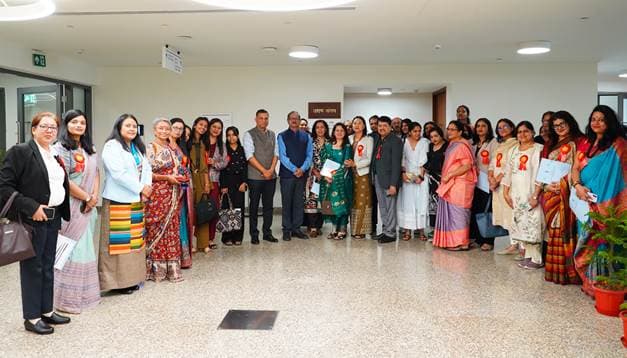
New Delhi: The Ministry of Micro, Small and Medium Enterprises (MSME) organised an awareness workshop on the Self-Reliant India (SRI) Fund to support women-led MSMEs at Kartavya Bhawan 3, New Delhi, as part of the Yashashvini Campaign. The event was chaired by MSME Secretary Bharat Khera.
The workshop brought together more than 60 women entrepreneurs from across the country, along with senior ministry officials and representatives of industry associations, NSIC Venture Capital Fund Limited (NVCFL), SBI Ventures Limited (SVL), Daughter Funds under the SRI Fund, NITI Aayog’s Women Entrepreneurship Platform (WEP) and the Atal Incubation Centre ALEAP Women Entrepreneurs Hub.
SRI Fund's role in providing growth capital
Additional Secretary and Development Commissioner Rajneesh outlined the journey of the SRI Fund, which was created to provide equity support to MSMEs beyond traditional bank lending. The government committed Rs 10,000 crore to the fund, with the expectation that private investors would contribute four times that amount.
He said some enterprises supported by the fund had grown their turnover three to four times within two to three years and subsequently raised additional capital from private investors. He urged industry associations to spread awareness about the fund among their members.
In his inaugural address, Khera said registrations on the Udyam and Udyam Assist portals crossed 10 crore on 30 October 2026, helping bring more enterprises into the formal economy. Women-owned enterprises account for 37.6% of these registrations. He called for increasing this share to 50%.
He said that formalisation had increased the Ministry's responsibility to help MSMEs expand, with access to growth capital being a key requirement.
Sharing the progress of the SRI Fund, Khera said commitments of Rs 8,305 crore had been made against its Rs 10,000 crore corpus, while nearly Rs 48,000 crore had been leveraged from private venture capital and private equity funds.
A total of 72 Daughter Funds have been empanelled. They have invested Rs 21,330 crore in 824 MSMEs, around 74% of which are micro enterprises. Of the enterprises supported, 77 have moved into a higher category, six have been listed on stock exchanges and 32 exits have been completed with profits.
Khera explained that Daughter Funds make investment decisions on commercial considerations, including business viability, growth over the previous three years and plans for achieving positive cash flows. The government maintains an arm's-length relationship with these funds and does not intervene in their day-to-day operations or investment decisions.
Credit and equity support for MSMEs
The Secretary stressed that credit and equity funding need to work together. He said outstanding MSME credit had increased from around Rs 10 lakh crore in 2014 to more than Rs 40 lakh crore, while non-performing assets in the sector had declined to about 3.5%.
He also highlighted the additional Rs 2,000 crore allocated to the SRI Fund for micro enterprises in the Union Budget 2026-27. Separately, the newly launched Rs 10,000 crore SME Growth Fund will provide direct investment to small and medium enterprises.
Khera advised entrepreneurs to maintain proper financial records and adopt suitable legal structures. He noted that bringing in equity could also improve an enterprise's ability to access debt.
Women entrepreneurs discuss funding challenges
The first session, titled The Growth Journey of Women-Led MSMEs – Why Growth Capital Matters, featured industry associations sharing their experiences of working with women entrepreneurs.
Participants highlighted the need for smaller investments for early-stage businesses, investment-readiness programmes in Tier-2 and Tier-3 cities, and assistance with accounting and business valuation. They also called for greater flexibility for entrepreneurs who may not have collateral or a long financial track record.
The discussion emphasised linking funding with market access through platforms such as the Government e-Marketplace (GeM), the Open Network for Digital Commerce (ONDC) and export channels. Participants also called for such workshops to be organised regularly.
In the second session, which focused on the structure of the SRI Fund and the role of Daughter Funds, Additional Development Commissioner Praveen Kumar explained that the Mother Fund invests through Daughter Funds, which in turn invest in MSMEs.
NSIC Chairman-cum-Managing Director Subhransu Sekhar Acharya discussed gaps in the MSME ecosystem and the benefits of equity funding. SBI Ventures Managing Director and CEO Prem Prabhakar, the investment manager of the SRI Fund, said equity could help enterprises expand without collateral requirements. Investors could also provide sector-specific guidance and support.
Representatives of Daughter Funds outlined key investment considerations, including market potential, management capability, scalability, audited financial statements, governance readiness and a clear plan for using the funds. They also explained the stages involved in securing equity investment, from initial screening to due diligence and documentation.
Incubation, mentorship and market access
The third session focused on support available through ecosystem partners. Representatives of the Atal Incubation Centre ALEAP Women Entrepreneurs Hub and WEP, NITI Aayog, presented available assistance in areas such as incubation, mentorship, market access, information on government schemes and regulatory compliance.
MicroSave Consulting (MSC), an ecosystem partner, provided technical support for the workshop's conceptualisation, planning and execution.
The final session featured an interactive question-and-answer discussion. Women entrepreneurs raised queries about approaching Daughter Funds, investment readiness for proprietorship-run businesses, sector-specific funding, and technology and infrastructure support.
Participants were informed that details of all 72 Daughter Funds, including their sector focus and contact information, are available on the website of NSIC Venture Capital Fund Limited, the special purpose vehicle for the SRI Fund.
The workshop concluded with the Ministry reaffirming its commitment to supporting women entrepreneurs through the Yashashvini Campaign.